
As IoT edge nodes, outdoor telemetry devices, compact sensors, and connected field hardware become smaller, the space available for environmental protection becomes more limited. A reliable sealing strategy is no longer a simple mechanical detail. It is a product-level engineering decision that affects enclosure structure, material selection, assembly method, serviceability, inspection planning, and long-term reliability.
For high-density IoT devices, the challenge is not only keeping moisture and dust away from the internal electronics. The real challenge is doing so while preserving product size, usability, repair access, thermal behavior, antenna performance, and repeatable production quality.
A sealing system that looks correct in CAD can still fail if gasket compression, enclosure tolerance, tooling variation, or assembly pressure is not reviewed early enough. This is why IP68-oriented design should be considered from the product architecture stage — before tooling decisions are locked and before the enclosure becomes difficult to change.
Why Sealing Fails in Compact Connected Hardware
In many connected hardware programs, sealing risk begins with a simple assumption: if the enclosure has a rubber ring or adhesive layer, the device is protected.
In reality, sealing performance depends on a much wider set of variables. The gasket must sit inside a controlled groove. The enclosure must maintain consistent pressure across the sealing path. The material must resist compression set over time. The assembly process must avoid uneven force.
The internal architecture must also allow enough room for screw bosses, clips, ribs, PCB clearance, antenna zones, and service access without breaking the sealing boundary.
For compact IoT devices, these requirements often compete with each other. A thinner enclosure may improve product feel but reduce gasket compression space. A smaller housing may improve portability but create tolerance risk. A serviceable battery door may improve maintenance but increase the number of sealing interfaces.
Good sealing design is therefore not a single component decision. It is a system decision.
Permanent Sealing: When Ultrasonic Welding Makes Sense
For rigid polymer enclosures that do not require future battery replacement, internal servicing, or frequent disassembly, ultrasonic welding can be a practical sealing strategy.
Ultrasonic welding uses high-frequency vibration to join compatible plastic surfaces along a defined weld line. When the enclosure geometry, material selection, weld energy director, and fixture design are properly reviewed, the process can create a strong and consistent enclosure bond without relying on exposed mechanical fasteners or secondary adhesive application.
This approach can be useful for sealed tracking nodes, compact sensor modules, or field devices where long-term environmental protection is more important than future access to internal components.
However, ultrasonic welding is not automatically the right answer for every product. Once the enclosure is permanently joined, serviceability becomes limited. Battery replacement, internal inspection, field repair, and certain end-of-life processes may become more difficult.
For this reason, BaysonTech treats welding strategy as part of the broader product architecture review, not simply as a manufacturing shortcut.
Precision CNC and Custom Elastomeric Gasketing
When a connected device needs to remain serviceable — such as modular field sensors, devices with swappable power modules, or products that may require maintenance access — permanent welding may not be the best solution.
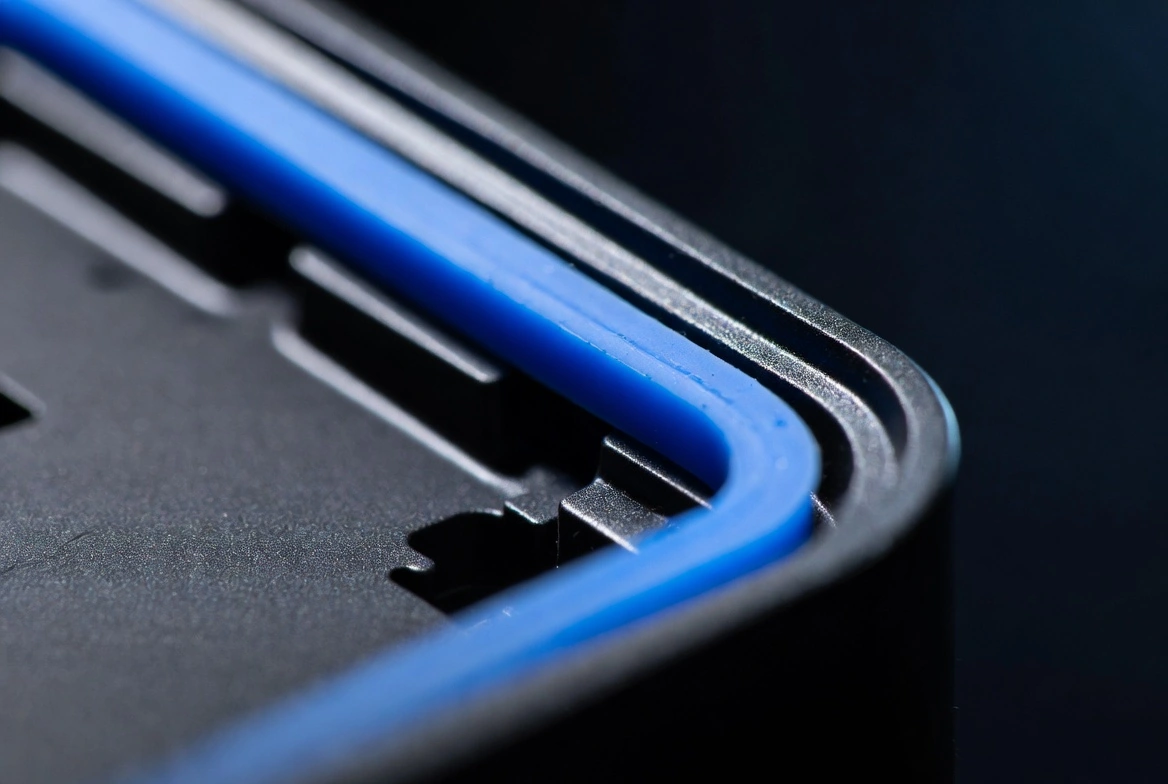
In these cases, sealing is usually built around a controlled mechanical interface. A retaining groove is designed into the enclosure, and a custom elastomeric gasket is placed into that groove to create a compression seal when the housing is assembled.

This type of sealing system requires careful review across several engineering decisions: gasket geometry, groove depth, enclosure tolerance, material compression, assembly pressure, and long-term deformation behavior.
For selected programs, BaysonTech supports the definition of CNC-machined groove requirements, elastomeric gasket specifications, compression-fit assumptions, and validation criteria. These decisions help the product maintain environmental protection while preserving serviceability, repair access, and production feasibility.
The goal is not simply to add a gasket. The goal is to design the sealing interface as part of the product architecture.
Designing for Repeatable Assembly
A sealing system must work not only in a prototype sample, but also across repeated assembly. This is where many hardware programs experience risk.
A prototype can be hand-adjusted. A production process cannot depend on hidden manual correction. If the seal only works when one skilled technician aligns the gasket perfectly by hand, the design is not ready for scalable production.
For this reason, sealing design should be reviewed together with assembly planning. The team needs to understand how the gasket is placed, how the enclosure is closed, how force is applied, what fixtures are required, and how the inspection process will identify sealing failures.
BaysonTech helps translate sealing intent into production-readiness requirements, including fixture assumptions, inspection checkpoints, assembly sequence, tolerance review, and quality-control expectations.
Leak-Test Planning for Production Readiness
A sealing strategy should not remain a theoretical design assumption. It needs to be translated into a practical inspection method before production.
For applicable programs, air-decay leak testing can be specified as part of the production-readiness plan. This process uses controlled pressure measurement to identify potential sealing failures that may not be visible during manual inspection.
The exact testing method depends on the product structure, sealing target, internal volume, fixture design, and quality requirements. Some programs may require air-decay testing. Others may use alternative environmental validation methods based on product risk, cost, and expected use conditions.
BaysonTech supports the definition of sealing criteria, inspection expectations, fixture requirements, and quality-control checkpoints for selected production programs. Final implementation is executed through approved manufacturing partners according to the agreed production files, quality requirements, and project scope.
From Environmental Protection to Product Trust
For high-density IoT devices, IP68-oriented design is not only about waterproofing. It is about trust in the product’s ability to survive real operating conditions.
A connected device may be exposed to humidity, dust, outdoor temperature changes, repeated handling, vibration, enclosure stress, and field maintenance. If the sealing system is not planned early, these conditions can create risk across electronics, battery systems, RF performance, firmware behavior, and user experience.
Strong environmental sealing therefore requires cross-functional decisions. Industrial design, mechanical structure, electronics layout, material selection, tooling strategy, assembly planning, and quality control must move together.
BaysonTech’s role is to keep these decisions connected — from product architecture and engineering direction to production-readiness planning and selected manufacturing execution. For hardware programs moving toward field use, sealing is not a late-stage detail. It is one of the decisions that must be owned before the product is built.
Key Takeaway
High-density IoT sealing requires more than a gasket, adhesive, or waterproof claim. It requires a controlled engineering system: enclosure tolerance, sealing path design, gasket material behavior, assembly pressure, inspection planning, and production-readiness discipline.
When these decisions are made early, the product is better prepared for tooling, validation, manufacturing execution, and long-term field reliability.